


Mark of Identity: Ali Omar’s “Nîşan” at ArTanit Gallery
- ArTanit Magazine Edition

- May 6, 2025
- 5 min read
“Nîşan” offers more than just a series of portraits. It’s an invitation to explore the malleability of identity, the symbolism of expression, and the ways in which visual language can create connections between the self and others. This evocative solo exhibition by Ali Omar, curated by Selim Cherif, is an artful exploration of personal and universal themes, running
from April 30 to May 27, 2025, at ArTanit Gallery.
The word “Nîşan” which translates to "mark" or "symbol" in Kurdish serves as the conceptual and emotional backbone of the exhibition. Through his powerful portraits, Ali Omar challenges traditional notions of identity, presenting a visual language that goes beyond individual representation to reflect a broader, collective human experience.
“The face I paint is not necessarily anyone’s face in particular,” Ali Omar explains. “It’s an expressive way to draw, with features that are common to all. The idea is to create a visual language that anyone can relate to. The face might belong to someone you know, or it might be you. It’s an invitation to engage with the common traits of human expression.”
In this way, “Nîşan” is about more than the mere act of portraiture; it is a profound commentary on the intersection of individuality and the collective, the unique and the shared. Each portrait is an emotional symbol, a mark of identity that speaks both to the artist’s personal experience and to a deeper, universal connection with the audience.

Rooted in the rich cultural heritage of a Syrian Kurdish family, Ali Omar also known as Eli Emer is an artist whose works transcend borders and speak to universal experiences of identity, belonging, and self-expression. Born in 1986 in Tabke, Syria, Ali’s journey as an artist began at a very young age, nurtured by the natural landscapes surrounding his hometown and the complex interplay of cultural identity that marked his upbringing. His works vivid, emotional, and brimming with symbolic depth reflect not only his personal journey but also the broader themes of identity that resonate in a world increasingly defined by fragmentation and connection.
Since relocating to Istanbul in 2015, the artist’s work has evolved, as he delves deeper into portraits that reflect not just individual likenesses, but the essence of identity itself.
In his latest exhibition, “Nîşan”, Ali distills the complexity of identity into a language of visual symbols, using portraits that transcend the specificities of individual likeness to communicate broader themes of connection, community, and shared human experience.
“Each identity, though unique, always shares something with others. It’s the commonality that unites us, even in our individuality,”
Ali reflects, summing up the core philosophy that drives much of his work. The concept of “Nîşan” which translates as "symbol" perfectly encapsulates Ali Omar’s artistic journey, as he uses visual language to explore how symbols shape our understanding of ourselves and our relationships with others.
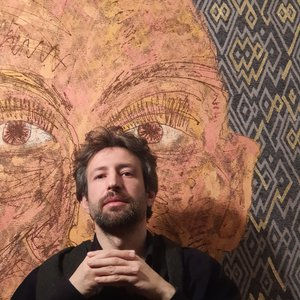
Exploring the Essence of Identity
Ali Omar’s approach to portraiture is rooted in the belief that identity is not static, but rather a fluid, evolving process. In his portraits, the facial features—though seemingly familiar—serve as a canvas for the expression of something much larger than any single person. Through each work, Omar examines the notion that identity is shaped by both internal forces and external influences, and in doing so, he speaks to the complexity of human experience.
“Each identity, though unique, always shares something with others. It’s the commonality that unites us, even in our individuality,” Ali reflects. “I love showing both the particularities and the common ground. That’s where the connection happens.”
In his exploration of this theme, Omar draws on his personal journey and cultural background. Growing up in a rural area surrounded by nature, he was deeply influenced by the landscapes that shaped his view of the world. The changing seasons—the green of spring, the yellow of fall, the grey of winter—became metaphors for life’s cyclical nature, inspiring his vibrant color palette and his approach to painting.
“The landscape around me was full of colors and shapes that I absorbed at a young age. I’ve always had a deep connection with nature. The colors, the seasons—they shaped my way of seeing the world, and that’s something you’ll find in my work,” he says.
The connection to nature is not just aesthetic, but also philosophical. The cycle of life—growth, decay, and rebirth—mirrors the human experience, and these themes are woven throughout “Nîşan”. The portraits are not merely representations of faces; they are expressions of life itself—constantly shifting, constantly evolving, yet always grounded in a shared human experience.

The Evolution of a Portrait
While “Nîşan” presents a refined body of work, it is also a continuation of Ali Omar’s artistic journey that began years earlier. Since relocating to Istanbul in 2015, The artist has focused predominantly on portraits, but his work is always evolving. With “Nîşan”, he presents a cohesive narrative that combines his past explorations of identity with a deeper, more expansive approach to form and visual language.
“This exhibition is not only about the current state I’m in, but also a continuation of what I’ve been working on for years,” Ali explains. “Since 2015, I’ve been focusing on portraits, but now I’m also working on a new series that expands beyond just faces. It’s about exploring different forms and perspectives. It’s an exciting new direction for me.”
This shift in his creative process represents an ongoing investigation into how identity can be both personal and universal. The work is now evolving into something more abstract, more fluid—integrating not only portraiture but also other forms that challenge the boundaries of how we perceive ourselves and each other.

A Dialogue with the Self
Perhaps one of the most fascinating aspects of Omar’s creative process is his relationship with his own work. Painting is not a solitary act for him; it is a dialogue—a constant conversation between himself and the canvas. This back-and-forth is an integral part of his artistic process and has allowed him to question not just the themes of identity and expression, but also his own assumptions and perceptions.
“My works speak to me, just as I speak to them,” Ali says, reflecting on the relationship he shares with his art. “There’s this ongoing dialogue throughout the creation process. It’s not always about finding answers, but questioning. The act of questioning itself is powerful—it pushes me to rethink my assumptions and my approach.”
This continuous exchange between the artist and the artwork enriches the final product, imbuing it with a depth that is palpable to the viewer. Each portrait in “Nîşan” speaks not just of the figure it represents, but of the emotional and intellectual journey the artist has undergone in creating it.
“The moment I painted the final portrait, I couldn’t continue for two days. I saw my father’s eyes in it—then my own. It became a very personal experience,” Omar confesses. “That moment, I realized I wasn’t just painting someone else. I was painting my own story.”
This moment of self-realization reflects the essence of “Nîşan”: a visual language that transcends the personal to become universal. The exhibition is not just about portraits; it is about identity as a living, evolving force that connects us to one another in ways we often cannot articulate.
Interview by: S.C for MAM magazine.


Comments